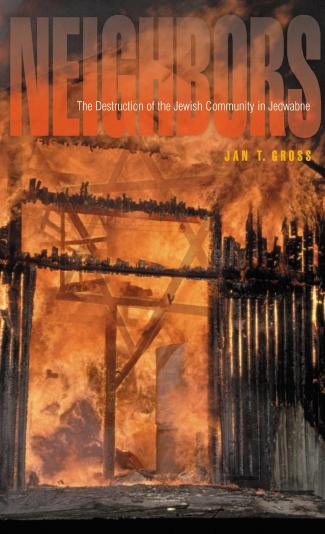
Neighbors: The Destruction of the Jewish Community in Jedwabne, Poland by Jan T. Gross
Author:Jan T. Gross [Gross, Jan T.]
Language: eng
Format: azw3, pdf, epub
Publisher: Princeton University Press
Published: 2012-09-17T04:00:00+00:00
COLLECTIVE RESPONSIBILITY
Even though the Nazi-conceived project of the eradication of world Jewry will remain, at its core, a mystery, we know a lot about various mechanisms of the “final solution.” And one of the things we do know is that the Einsatzgruppen, German police detachments, and various functionaries who implemented the “final solution” did not compel the local population to participate directly in the murder of Jews. Bloody pogroms were tolerated, sometimes even invited, especially after the opening of the Russo-German war—a special directive was issued to this effect by the head of the Main Reich Security Office, Reinhardt Heydrich.1 A lot of prohibitions concerning the Jews were issued as well. In occupied Poland, for example, people could not, under penalty of death, offer assistance to Jews hiding outside of the German-designated ghettos. Though there were sadistic individuals who, particularly in camps, might force prisoners to kill each other, in general nobody was forced to kill the Jews. In other words, the so-called local population involved in killings of Jews did so of its own free will.
And if in collective Jewish memory this phenomenon is ingrained—that local Polish people killed the Jews because they wanted to, not because they had to—then Jews will hold them to be particularly responsible for what they have done. A murderer in uniform remains a state functionary acting under orders, and he might even be presumed to have mental reservations about what he has been ordered to do. Not so a civilian, killing another human being of his own free will—such an evildoer is unequivocally but a murderer.
Poles hurt the Jews in numerous interactions throughout the war. And it is not exclusively killings that are stressed in people’s recollections from the period. One might recall, for illustration, a few women described in an autobiographical fragment, “A Quarter-Hour Passed in a Pastry Shop,” from a powerful memoir by Michał Głowiński, today one of the foremost literary critics in Poland. He was a little boy at the time of the German occupation. On this occasion an aunt had left him alone for fifteen minutes in a little Warsaw café; after sitting him down at a table with a pastry, she went out to make a few telephone calls. As soon as she left the premises, the young Jewish boy became an object of scrutiny and questioning by a flock of women who could just as well have left him in peace.2 Between this episode and the Jedwabne murders one can inscribe an entire range of Polish-Jewish encounters that, in the midst of all their situational variety, had one feature in common: they all carried potentially deadly consequences for the Jews.
When reflecting about this epoch, we must not assign collective responsibility. We must be clearheaded enough to remember that for each killing only a specific murderer or group of murderers is responsible. But we nevertheless might be compelled to investigate what makes a nation (as in “the Germans”) capable of carrying out such deeds. Or can atrocious deeds
Download
Neighbors: The Destruction of the Jewish Community in Jedwabne, Poland by Jan T. Gross.pdf
Neighbors: The Destruction of the Jewish Community in Jedwabne, Poland by Jan T. Gross.epub
This site does not store any files on its server. We only index and link to content provided by other sites. Please contact the content providers to delete copyright contents if any and email us, we'll remove relevant links or contents immediately.
Personalized inhaled bacteriophage therapy for treatment of multidrug-resistant Pseudomonas aeruginosa in cystic fibrosis by unknow(214566)
CONSORT 2025 statement: updated guideline for reporting randomized trials by unknow(102521)
Critical evaluation of the ProfiLER-02 study design and outcomes by Vivek Subbiah & Razelle Kurzrock(102046)
Cardiac gene therapy makes a comeback by Oliver J. Müller & Susanne Hille & Anca Kliesow Remes(101838)
Whisky: Malt Whiskies of Scotland (Collins Little Books) by dominic roskrow(74619)
Unveiling the design rules for tunable emission in graphene quantum dots: A high-throughput TDDFT and machine learning perspective by Şener Özönder & Mustafa Coşkun Özdemir & Caner Ünlü(51002)
A yeast-based oral therapeutic delivers immune checkpoint inhibitors to reduce intestinal tumor burden by unknow(40374)
Covalent hitchhikers guide proteins to the nucleus by Alexander F. Russell & Madeline F. Currie & Champak Chatterjee(40296)
Meet the Authors: Christopher R. Mansfield and Emily R. Derbyshire by Christopher R. Mansfield & Emily R. Derbyshire(40206)
Alkaline-earth metals promote propane dehydrogenation with carbon dioxide through geometric effects: Altering the reaction pathway by unknow(32814)
Induced iron vacancies boosting FeOOH loaded on sustainable Fenton-like collagen fiber membrane for efficient removal of emerging contaminants by unknow(32610)
Efficient electric-field-assisted photochemical conversion of methane to n-propanol exclusively over penetrated TiO2Ti hollow fibers by Guanghui Feng(32529)
Bi2SiO5 nanosheets as piezo-photocatalyst for efficient degradation of 2,4-Dichlorophenol by Hangyu Shi & Yifu Li & Lishan Zhang & Guoguan Liu & Qian Zhang & Xuan Ru & Shan Zhong(32468)
A novel NDIPTA organic heterojunction photocatalyst with built-in electric field for efficient hydrogen production by Jiahui Yang & Baojun Ma & Yongfa Zhu(32443)
Enhanced conversion of methane to liquid-phase oxygenates via hollow ferrite nanotube@horseradish peroxidase based photoenzymatic catalysis by Jun Duan & Shiying Fan & Xinyong Li & Shaomin Liu(32405)
Ordered macroporous superstructure of defective carbon adorned with tiny cobalt sulfide for selective electrocatalytic hydrogenation of cinnamaldehyde by Xiao-Shi Yuan & Sheng-Hua Zhou & San-Mei Wang & Wenbo Wei & Xiaofang Li & Xin-Tao Wu & Qi-Long Zhu(32335)
What's Done in Darkness by Kayla Perrin(27256)
Topological analysis of non-conjugated ethylene oxide cored dendrimers decorated with tetraphenylethylene: Insights from degree-based descriptors using the polynomial approach by A Theertha Nair & D Antony Xavier & Annmaria Baby & S Akhila(26631)
Investigation of mechanical and self-healing properties of hydroxyl-terminated polybutadiene functionalized with 2-ureido-4-pyrimidinone by Mohsen Kazazi & Mehran Hayaty & Ali Mousaviazar(26555)
